How Sprinklers Work 

download leaflet Watermist  

Click to see animation

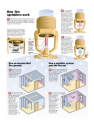
  • Fire Sprinklers are simple devices that are individually operated directly by the heat from a fire - as is shown in the diagram below right.

  • When a fire starts a plume of hot gases rise to the ceiling. If a sprinkler is present, a glass bulb or solder link gets hot and at a specific temperature (typically 68°C) breaks releasing the cap and allowing water to flow onto a specially designed diffuser.

  • The diffuser breaks up the water flow into carefully controlled droplets, which penetrate the fire plume and cool the burning material to below its ignition point, thus putting out the fire.

  • Only the sprinkler/s directly over the fire are operated - not all of them!.

  • The sprinklers are connected to pipework, usually filled with water, which is supplied either from the water mains or from a storage tank via a pump.

  • When a sprinkler operates the flow of water in the pipework operates a flow switch, which in turn operates an alarm system.

  • The flow of water is small, typically less than 1/100th the water used by the Fire Brigade.

  • Sprinklers do not go off accidentally and are only triggered by the heat from real fires.

  • Sprinklers are very reliable and less then 1:16,000,000 exhibit any form of manufacturing defect. 

Click to download

  • A sprinkler is similar to a hose nozzle because it breaks up the stream of water into a fine spray. A cap normally seals the waterway.
  • The cap is held in place by either a glass bulb or two thin pieces of metal that are soldered together.
  • A fire creates a a narrow plume of hot air and gasses that rise to the ceiling and spread out. When the hot gases reach the nearest sprinkler they will heat the fusible element or glass bulb that holds the cap in place.

  • When hot enough the cap will fall away and the sprinkler will spray water on the fire.

  • Because the water immediately cools the hot fire gases, the other sprinklers usually won't open because there would not be enough heat to break the bulb or melt their fusible element.

  • If the fire is so hot that one sprinkler cannot handle it alone, hot gases will reach the next nearest sprinkler. Then that sprinkler would open to stop the fire.

  • This design of opening only when there is enough heat limits the number of sprinklers to what is needed to stop the fire.

  • Fire records over the past century show that 93 percent of fires were handled by only one sprinkler. In the remaining cases, two sprinklers handled an additional four percent. and it took only three sprinklers to handle nearly all of the remaining 3 percent.

  • Keep in mind that these figures include large warehouses with high piles of combustible goods, some of them very combustible. In these cases, more than one sprinkler may be necessary to spray enough water to absorb the tremendous heat generated by the fire.

  • In residential settings, the likelihood of more than one sprinkler opening is very rare, and the number of fires controlled by one sprinkler is much closer to 100 percent.

  • The water spray from the sprinkler cools the fire gases over the fire. When the temperature of the burning material drops to below its combustion temperature, it can no longer burn and the fire goes out.

  • Responding firefighters will shut off the sprinkler only once they are sure that the fire is completely out.

  • Right is a close-up view of a ceiling-mounted fire sprinkler.
  • The exposed part (what you can see on the ceiling) of this sprinkler measures 1 5/8" long and 1 1/4" wide. Many residential fire sprinklers are recessed into the ceiling so that as little as 1/2" is visible and some are completely recessed and covered with flat caps that match the ceiling.
  • The threaded end at the top screws into a water pipe in the ceiling and is not visible from below.

  • The cap/seal prevents water from flowing out. The glass bulb holds the cap/seal in place

  • The glass bulb is filled with liquid and a small bubble.

  • Heat from a fire will expand the liquid and break the bulb. The cap/seal falls away and water will stream out.

  • The water stream hits the deflector, which breaks it into a spray of tiny droplets, which cools the source of the fire thereby extinguishing it.

Sprinklers come in a variety of designs to suit any application and these include pendent, recessed, concealed and sidewall sprinklers. See pictures

As a result a residential sprinkler system is usually completely concealed within the walls and floors of a property and so goes unnoticed by visitors - as can been seen on the left.

Can you spot the sprinkler?

Concealed sprinkler.

Only the white disc shows below ceiling

Recessed sprinkler.

Sprinklers can be factory supplied in any colour or finish

More sprinkler pictures